Development Overview
This section outlines various principles which govern how we develop the Blender Niftools Addon and why.
Development Methodology
A development methodology describes the principles we want as part of the development process.
For the latest series of development, we decided to develop a Feature-Oriented, Test Driven Development (TDD) methodology to suit both current and future needs.
Test-driven development in a nutshell means:
We write a test for some functionality we want. We run the test, initially it will fail. We code the feature. We re-run our tests, changing the code until it passes.
The advantages of TDD is:
It gives us quick feedback when changes arise. Constantly testing the code to ensure that it is doing what is meant to do, no assumptions.
When things break, it narrows the search; allowing fixes to be developed more quickly.
Ensure that the changes haven’t broken any other existing functionality.
The focus of our TDD methodology is 3 main areas:
Develop maintainable code - Ensure good foundation for stable development and improvement
Constant feedback - Testing features ensuring they work and remain working
Documentation - Ensure that people can actually use the tools, think about user perspective
Code Development & Maintenance
The initial proposal was to port all the current code directly to the new Blender Python API. See Code Porting Strategy
Additionally,
It was decided that as the code was ported that the conventions as described in the next section would be introduced to keep the code consistent and improve readability.
Refactored of code into modular components when working on features sets; collisions, texture, armature, etc.
Modularisation
During the code porting process it became apparent that the code was monolithic. All of the import code was in one class, all export code in another.
Initially, we planned to hold off large-scale refactoring until the code was ported and do it as part of the 3.0.x series. It was decided to separate out common areas of functionality into submodules which would be responsible for that specific areas.
Note
Some systems are still highly coupled, such as geometry generation within the material system. These will remain in place.
Modularisation of code makes it much easier to add on new functionality, such as new collision type, when the code is localized. This will also make the refactoring process easier as we can target specific areas.
Git Development Model
We use git as our version control system. In order to facilitate parallel development of a single code base, we
developed a git workflow based on the popular nvie gitflow model.
The goals were:
A central clean repository which everyone forks from, avoids new developer cleaning up unwanted branches
Developers create feature branch off develop, rebase if develop is updated
A central repository to accept pull requests, for peer review.
Merge code into develop, developers synch with central.
When a develop forks from the central repo, their repo will have only 2 branches, master and develop.
Their primary use is tracking updates from central; only changes should be those pulled from the central repo.
Develop is used as the base to create feature branches.
If develop is updated, then all feature branches should be rebased. This reduces conflicts for pull requests sent to the central repo.
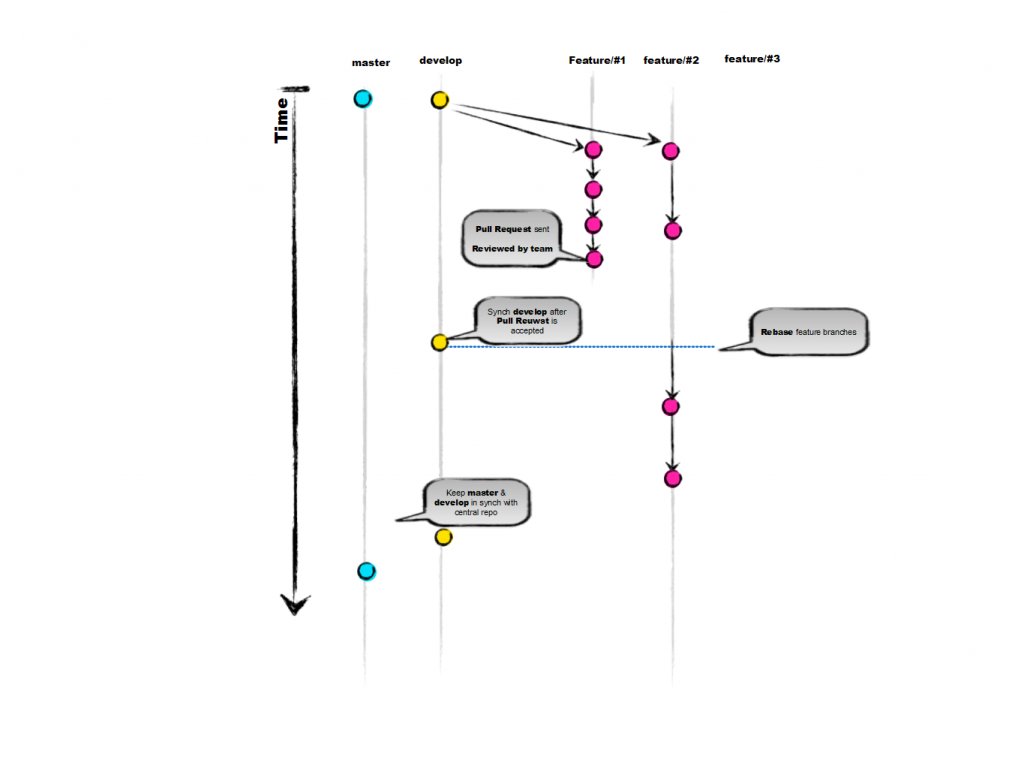
When a developer feels that their feature branch is ready they can start the review process: * A pull request needs to be sent to the central repo against the develop branch. * A review for that specific project will review the pull request If they are happy with the changes it will be merged * into develop and all active developers will be notified to pull the changes into their local repos. * If additional changes are required then the pull request if left open and the developer can add commits to their repo which get automatically added to the pull request.
Test-Framework
In Test Driven Development, tests are the core of ensuring software quality. Before any production code is written, a test should be written to check to see that the code does what it does. Initially, the tests will fail. As the code is developed, then more tests should pass until all tests do. At this point, a feature is deemed to be implemented.
Some points of note:
It is up to the developer to create tests which are appropriate in the level of testing.
Previously, tests were created ad-hoc, based often on bug fixes, so did not extensively test the code. It was decided that we would develop a test-framework to standardise testing in parallel to the porting process.
The current goal of the test-framework is to provide integration level testing to ensure features function as required.
The Test Framework has several purposes:
Standardise testing through the use of the template pattern.
Provide functionality testing as features are ported to the newer API.
Act as a regression suite so that future changes to the API will be detected.
Provide a list of supported addon features by testing features and asserting that they are known to be working.
Provide documentation of features by recreating user interaction.
Feature Tests Creation
Supporting features is detailed workflow is detailed in the Test Framework Section.
Documentation
Documentation forms the final core principle of development. Without documentation that enable users to understand how to use the addon, there is not much point in development.